
Retrain Your Brain for Happiness: The 2-Minute Habit Backed by Science
You get to the end of the day. You’re tired. Your brain scrolls through the endless to-do list: the frustrating meeting, the traffic, the emails you still haven’t answered. When your head finally hits the pillow, what’s the one thing that loops in your mind?
For most of us, it’s the one thing that went wrong.
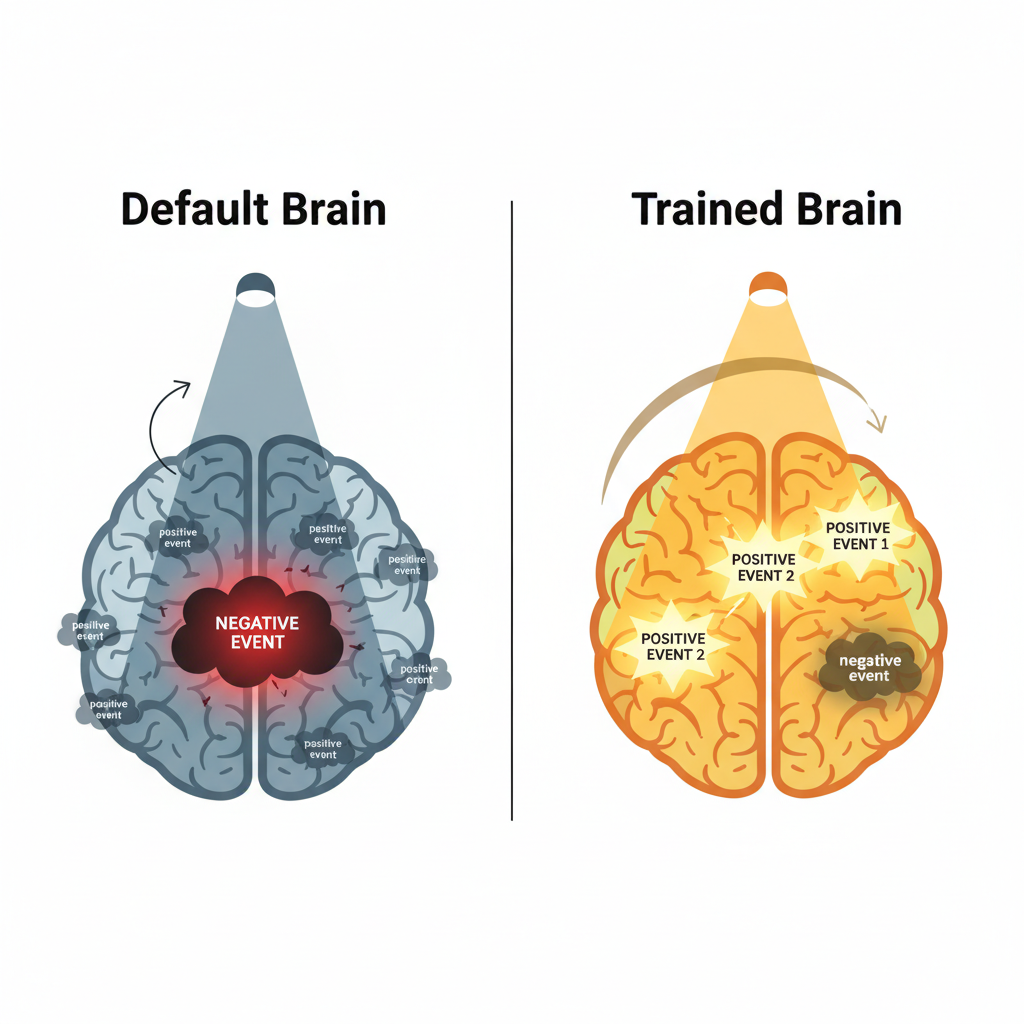
You’re not broken. It’s your brain doing its job. We are all hardwired with a “negativity bias”—an ancient survival tool that makes our minds like Velcro for bad experiences and Teflon for good ones.
But what if you could take just two minutes to actively retrain that bias?
This isn’t about pretending problems don’t exist. It’s a practical, science-backed exercise to make sure the good moments get logged, too. It’s called the “Three Good Things” practice, and it’s one of the most effective tools in positive psychology.
What’s Really Happening When You’re Grateful?
At TheBrainSpa, we focus on practical tools that change your brain. Gratitude isn’t just a “nice” feeling; it’s a powerful cognitive tool.
Dr. Martin Seligman, the founder of Positive Psychology, describes gratitude as a positive emotion focused on the past. When you deliberately practice it, you are actively steering your attention. You’re forcing your brain to scan the last 24 hours for wins, not just threats.
This simple act amplifies your good memories. Instead of letting a good moment disappear, you are acknowledging it, logging it, and strengthening the neural pathway associated with it.
The Hard Science Behind This “Soft” Skill
This isn’t just a self-help theory; it’s a documented intervention. Researchers have studied this exact practice, and the results are impressive.
1. The Core Study: Counting Blessings
The most famous research on this comes from Drs. Robert Emmons and Michael McCullough. In their studies, they had participants keep a weekly gratitude journal.
The result: Compared to a group that just wrote about daily hassles, the “gratitude group” reported:
- Higher levels of happiness and optimism.
- Fewer physical symptoms of stress.
- They even spent more time exercising and were more likely to help others.
2. The Proof: “Three Good Things”
Dr. Seligman’s own research tested the “Three Good Things” exercise directly. Participants were asked to write down three things that went well each day and their causes.
The result: This simple 2-minute habit significantly increased their levels of happiness and decreased depressive symptoms. Even more amazing? The positive effects were still measurable six months later. This isn’t just a quick fix; it’s a long-term change.
3. Why It Works: Fighting the Negativity Bias
This practice is a direct counter-measure to your brain’s default setting.
- It forces a new focus: You start looking for good things during your day, knowing you’ll need them for your list later.
- It builds proof: You are creating a running log of evidence that your life is better than your negativity bias wants you to believe.
- It builds satisfaction: By focusing on gratitude, you are actively wiring your brain for overall life satisfaction.
Your 2-Minute Brain-Training Exercise
Ready to try it? This is the exact, simple exercise.
Your 7-Day Challenge:
- Get a Notebook: Tonight, before bed, put a notebook and pen by your bed.
- List Three Things: Write down three things that went well for you today. They can be tiny (“My coffee was perfect”) or big (“I finished that huge project”).
- Find the Cause: This is the most important part. Next to each good thing, write down why it happened.
- Instead of: “My partner was nice to me.”
- Write: “My partner brought me tea because they noticed I was stressed.”
- Instead of: “I finished my report.”
- Write: “I finished my report because I focused and worked hard for an hour.”
That’s it. Do this for seven nights in a row and just notice how you feel.
Ready for the Next Level? Try the “Gratitude Visit”
If you want a powerful, immediate happiness boost, the research points to a deeper practice called the Gratitude Visit.
- Think of one person who is still alive who did something that positively changed your life, but whom you never properly thanked.
- Write a one-page letter to them (about 300 words). Be specific about what they did and how it affected you.
- Call them and arrange to visit. Do not tell them the real reason.
- When you meet, read the letter aloud to them, making eye contact.
This is a big one. It’s deeply emotional. But in studies, the Gratitude Visit has been shown to cause the largest immediate spike in happiness of any positive psychology intervention.
Conclusion: It’s Not Magic, It’s Training
Lasting well-being isn’t built by huge, life-changing events. It’s built by small, deliberate, daily habits.
The “Three Good Things” exercise is mental training. It’s the simple, conscious act of teaching your brain to log the good, not just the bad. You’re not ignoring your problems; you’re just balancing the books.
Why not start tonight?
References:
- This article is based on the concepts presented in Authentic Happiness by Martin E. P. Seligman, Ph.D.
- Emmons, R. A., & McCullough, M. E. (2003). “Counting blessings versus burdens: An experimental investigation of gratitude and subjective well-being in daily life.” Journal of Personality and Social Psychology.
- Seligman, M. E. P., Steen, T. A., Park, N., & Peterson, C. (2005). “Positive Psychology Progress: Empirical Validation of Interventions.” American Psychologist.